The courage to be disliked
This book is a primer on the philosophy of Alfred Adler, presented in a dialogue format between a philosopher and a young man seeking answers about life and happiness. The central theme revolves around the idea that true freedom and happiness come from having the courage to be disliked by others. That freedom and happiness come from letting go of approval, accepting responsibility for your choices, and living according to your own values while contributing to others.
1. Past Does Not Determine the Present (Teleology over Causality)
The past is a tale the mind still repeats,
A shadow that follows but bows to new feats.
What happened has weight, yet no sovereign claim,
For meaning, not memory, authors the frame.
The book argues that people are not shaped by past trauma, but by the meaning they assign to experiences. This idea—called teleology—says behavior is goal-oriented, not cause-driven. You are not the victim of your past; you are the author of your present choices.
A person who says, “I cannot trust people because I was betrayed” may actually be using that experience to justify a present goal—such as avoiding intimacy, responsibility, or the risk of rejection. The memory becomes a tool, not a chain.
This perspective is deeply empowering but uncomfortable. It removes the comfort of victimhood. If the past does not control the present, then responsibility returns to the individual. One cannot indefinitely blame parents, society, or fate. Freedom and responsibility arrive together.
Changing one’s life does not require changing the past. It requires changing one’s interpretation and purpose. The moment the goal changes, behavior changes. This is why insight alone is insufficient; transformation requires courage—the courage to choose a new way of being.
Ultimately, this idea restores agency. Life is not something that merely happened to you. It is something you are continuously choosing, moment by moment.
Life style
And what you continually choose to be is what Adler says, is your lifestyle. Lifestyle is not a habit you form, a routine you follow or a personality you inherit. It is the way you choose to interpret and respond to life’s challenges, the narrative you create about who you are and what your life means.
A self-chosen pattern of meaning and movement toward life
— formed early, but maintained by present choice.
It is the unconscious strategy a person adopts to answer three core questions:
Who am I?
What is the world like?
How do I belong and matter?
This strategy shapes how a person:
approaches relationships,
responds to difficulty,
pursues significance,
and avoids perceived defeat.
Lifestyle is goal oriented and not past oriented (unlike Freud). It is flexible and can be changed with courage and intention. By becoming aware of one’s lifestyle, a person can choose to revise it—to adopt new meanings, goals, and ways of being that lead to greater freedom and fulfillment.
The concept of Lifestyle explains why people are consistent without determinism. Lifestyle is stable because it is useful, not because it is fixed. It is useful to serve belonging.
Adler acknowledges that early experiences influence lifestyle formation, but he emphasizes that individuals have the power to reinterpret and reshape their lifestyles throughout life. This dynamic view of personality highlights the potential for growth and change, even in adulthood.
The past influences the lifestyle, but the lifestyle interprets the past — and the present always holds the power to choose anew.
People fabricate emotions
Emotions are not reactions to events,
But stories we tell to justify intents.
People do not feel hurt because of what others do. They feel hurt because of the meaning they assign to those actions. Emotions are fabricated to support one’s chosen lifestyle and goals. For example, feeling rejected may serve the goal of avoiding intimacy. Feeling angry may justify asserting control. Emotions are not objective responses; they are subjective narratives that align with one’s purpose. By changing the narrative, one can change the emotional experience.
2. All problems are interpersonal
All suffering rises where mirrors are placed,
Where selves are compared, ranked, measured, and chased.
No ache lives alone, no wound stands apart,
Each pain is a distance from heart to heart.
Adler claimed that every psychological problem is rooted in relationships. Anxiety, anger, jealousy, inferiority, and loneliness all arise from how we perceive ourselves in relation to others.
Even emotions that feel internal are relational at their core. Inferiority exists only in comparison. Anger often emerges when one feels wronged by another. Loneliness presupposes the desire for connection. If a person were alone on an island, many psychological struggles would vanish.
The book argues that suffering intensifies when we become overly concerned with how we appear to others. When self-worth depends on external validation, life becomes a performance. Fear of judgment replaces authenticity, and freedom quietly disappears.
Importantly, Adlerian psychology does not advocate isolation. It advocates healthy relatedness—relationships without domination, submission, or dependency. Problems arise not because others exist, but because we seek approval, superiority, or control within relationships.
Understanding this shifts the solution as well. Healing does not come from endless introspection alone, but from redefining how one engages with others—on terms of equality, respect, and responsibility.
3. Detach from the need for approval
Freedom arrives without trumpet or cheer,
It enters when praise is no longer held dear.
To walk unapproved, yet inwardly sound,
Is to stand on a truth not borrowed from ground.
Freedom begins when you accept that:
You cannot control how others judge you
Being disliked is not a failure, but evidence of living honestly
The courage to be happy includes the courage to be disliked.
Trying to please everyone traps you in anxiety and resentment.
This is the emotional heart of the book. To live freely is to accept the possibility—sometimes the certainty—of being disliked.
Approval-seeking is portrayed as a hidden form of bondage. When your happiness depends on being liked, you surrender authorship of your life. Choices become calculated for applause rather than alignment with values.
The book makes a striking claim: wanting universal approval is neither realistic nor virtuous. It is a sign of fear. To be disliked is not proof of failure; it is evidence that you are living your own life instead of someone else’s expectations.
This does not mean behaving selfishly or cruelly. It means acting sincerely, even when sincerity invites disagreement. Courage is required because rejection threatens our sense of belonging. Yet paradoxically, only those willing to risk rejection can form genuine connections.
Adlerian freedom is not rebellion for its own sake. It is quiet self-trust. The courage to be disliked is the courage to say: “This is my life, and I will bear the responsibility of living it honestly.”
4. Separation of tasks (Emotional boundaries)
Let tasks fall away to the hands they belong,
Where blame grows exhausted and peace grows strong.
One life bears its choosing, another its view,
What others make of it is never for you.
A central idea is task separation:
My task: How I live, what I choose, how I act.
Your task: How you feel about it, and how you act.
If someone disapproves of your choices, that reaction is their task, not yours. This boundary creates emotional clarity and inner peace.
One of the most practical teachings in the book is task separation. Many interpersonal conflicts persist because people interfere in tasks that are not theirs.
Your task consists of:
- Your actions
- Your choices
- Your values and effort
Others’ tasks consist of:
- Their feelings
- Their judgments
- Their reactions
If you act sincerely and someone disapproves, that emotional response belongs to them. Attempting to manage it is a violation of boundaries—and a source of anxiety.
Task separation does not mean indifference. It means clarity. You can care deeply about others while refusing to live under their evaluation. This distinction liberates both sides: you from control, and them from dependency.
Much emotional exhaustion comes from living other people’s tasks—trying to prevent disappointment, anger, or misunderstanding. The book teaches that peace emerges when responsibility is returned to its rightful owner.
5. Equality, and contribution! Not competition
Comparison bends every mirror to lie,
One climbs only when another must die.
But worth is not taller when others are small,
No crown can be raised from a needless fall.
The book rejects hierarchical thinking (“better than / worse than”).
True confidence comes from:
Seeing all people as equal in worth
Shifting from competition to contribution
You don’t need to be superior—only useful and sincere.
Feelings of inferiority are universal. Adler did not see them as pathological; he saw them as the starting point of growth. Problems arise when inferiority turns into comparison.
He terms this as a pursuit towards superiority, i.e. having a growth mindset. But when this pursuit is based on outdoing others, it becomes toxic. Rather, it is that everyone is walking in teh same flat place. The pursuit of superiority is the mindset of taking a single step forward on one’s own feet, not the mindset of competition of the sort that necessitates aiming to be greater than other people.
When life is viewed as a competition, every interaction becomes a ranking system. Someone must be above, someone below. Success becomes relative, never sufficient. Even achievement breeds anxiety—because someone else may surpass you.
The book argues that true confidence does not come from superiority, but from abandoning comparison altogether. People are not on the same racecourse. Each life follows its own path.
By rejecting hierarchy, one also rejects resentment and envy. There is no need to defeat others to affirm oneself. Value is intrinsic, not earned through dominance.
This shift is subtle but profound: from “How do I win?” to “How do I live well?”. And living well is about how i contribute to others, not how I outperform them.
6. Community feeling over self-centeredness
Happiness waits not at triumph’s bright gate,
Nor bows to success or the favor of fate.
It grows in contribution, humble and still,
In offering presence, not bending one’s will.
Happiness arises when you feel you belong and contribute.
Even small acts of contribution—kindness, responsibility, honesty—create meaning.
A fulfilling life is not about recognition, but participation.
Happiness, in Adlerian psychology, arises from community feeling—the sense that one belongs and contributes.
This does not require grand achievements. Contribution can be quiet, ordinary, and unseen. What matters is the inner conviction that one is useful, connected, and participating in life.
When people feel useless, they seek recognition.
When they feel they belong, recognition becomes unnecessary.
The book reframes love, work, and friendship as arenas of contribution rather than validation. Meaning grows not from being praised, but from giving without bargaining.
This idea directly counters modern hyper-individualism. Fulfillment is not found in self-obsession, but in self-transcendence.
7. Happiness is a choice. Not a destination.
Joy is not stolen, demanded, or won,
It blooms when the courage to live has begun.
Chosen in daylight, in failure, in fear,
It asks no permission to quietly appear
The bravest of lives is gentle and true,
Not loud in its claims nor eager for view.
Rooted in self, yet turned toward the whole,
A life lived in courage becomes a shared soul.
Happiness is not a reward for success or approval. It is a decision to live courageously, authentically, and responsibly—here and now. Happiness is not something you pursue; it is something you decide. This does not deny suffering. It denies the belief that happiness must wait for perfect conditions. Happiness is the courage to live presently, sincerely, and responsibly—even amid uncertainty.
Choosing happiness means
- Accepting oneself without conditions
- Letting go of approval
- Contributing without guarantees
- Living without excuses
8. The definition of Self (Meaning, Identity, and Relationship to Oneself)
Definition
This task concerns:
- self-acceptance,
- finding meaning,
- developing a sense of worth independent of approval.
Adler’s view Although Adler did not formalize this as a separate task, his work clearly implies it.
This task asks:
“Can I accept myself as I am, and still move forward?”
Failure here often underlies failure in all other tasks.
Pathology here looks like:
- shame,
- inferiority complexes,
- identity confusion,
- existential emptiness.
9. The 3 life tasks: love, work, friendship
Meaning · Identity · Self-Acceptance
"**I am worthy to belong and to contribute**."") WORK("WORK
Contribution · Usefulness
**How do I give?**") FRIENDSHIP("FRIENDSHIP
Community · Equality
**Do I belong?**") LOVE("LOVE
Intimacy · Commitment
**Can I share?**") SELF --> WORK SELF --> FRIENDSHIP SELF --> LOVE
In Alfred Adler’s Individual Psychology, life tasks are the fundamental arenas in which every human must learn to live, cooperate, and find meaning. Mental health, in Adler’s view, is not an inner state but the ability to meet these tasks with courage, equality, and social interest.
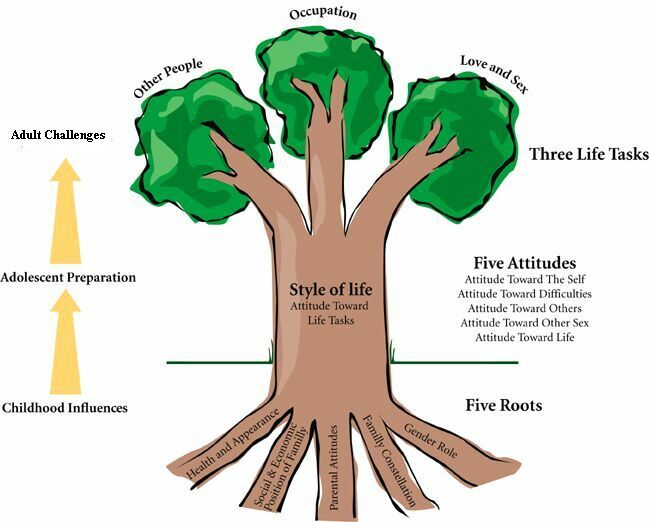
Life Task 1 - Work (Occupation / Contribution)
Definition
The task of work is not merely employment. It is the ability to:
- contribute to society,
- feel useful,
- take responsibility,
- cooperate with others toward shared goals.
This life task of Work answers the question:
“How do I contribute to the common good?”
A person avoiding this task may:
- feel chronically inferior,
- seek shortcuts to recognition,
- or rely on others for validation or support.
Work becomes healthy when:
- it is approached as contribution, not competition,
- effort matters more than status,
- usefulness replaces superiority.
Pathology here looks like:
- fear of failure,
- perfectionism,
- workaholism (as superiority),
- or total avoidance.
Life Task 2 - Friendship (Social Relationships / Community)
Definition
The task of friendship involves:
- cooperation,
- mutual respect,
- equality,
- the ability to belong without dominance or submission.
Adler’s view Humans are social beings. Psychological suffering arises when one:
- fears rejection,
- seeks approval compulsively,
- or withdraws to avoid vulnerability.
Friendship requires:
- courage to be seen,
- acceptance of difference,
- willingness to give without controlling.
Pathology here looks like:
- loneliness,
- people-pleasing,
- social anxiety,
- manipulation or withdrawal.
Life Task 3 - Love (Intimate Relationships)
Definition
The task of love is the deepest relational challenge:
- forming a partnership based on equality,
- sharing life without possession,
- committing without domination.
Adler’s view Love tests whether a person can: - move beyond self-centeredness,
- accept another as equal,
- risk rejection and loss.
Healthy love requires:
- courage,
- mutual responsibility,
- and shared purpose.
Pathology here looks like:
- jealousy,
- control,
- fear of intimacy,
- emotional dependency or avoidance.
How Life Tasks Connect to Lifestyle
A person’s lifestyle determines:
- how they approach each task,
- which tasks they avoid,
- and which excuses they use.
Mental health is not perfection in all tasks, but engagement without avoidance.
Symptoms often serve to:
- escape a life task,
- protect against failure,
- or maintain a sense of superiority or safety.
Mental health is the courage to meet life’s tasks with social interest and equality. Not happiness. Not success. But participation.
Life is not a problem to be solved,
but a set of tasks to be courageously lived.
Defined by the
10. Life’s lies
Work · Friendship · Love"] B["FEAR OF FAILURE
Rejection · Inferiority · Loss"] C["LIFE'S LIES
(False Convictions)"] D1["Lies about SELF
“I am incapable / broken / special”"] D2["Lies about OTHERS
“People are unsafe / judgmental”"] D3["Lies about WORLD
“Effort is pointless / unfair system”"] E["AVOIDANCE
Withdrawal · Control · Perfectionism"] F["SYMPTOMS
Anxiety · Depression · Anger"] G["STABLE LIFESTYLE
(Feels safe, not free)"] H["COURAGE & INSIGHT
Task Engagement"] I["TRUTH
Equality · Contribution · Choice"] A --> B B --> C C --> D1 C --> D2 C --> D3 D1 --> E D2 --> E D3 --> E E --> F F --> G G --> B H --> I I --> A
In Alfred Adler’s Individual Psychology, “life’s lies” are false convictions a person adopts to avoid life’s tasks while protecting self-esteem. They are not conscious deceptions, but deep assumptions that make avoidance feel justified and safe.
Put simply :
Life’s lies are beliefs
that make us feel right
while keeping us stuck.
They explain why someone does not engage fully with work, love, friendship, or self-acceptance.
According to Alfred Adler, when facing life’s demands, humans often choose psychological safety over courage. To preserve a sense of worth, the mind invents lies about self, others, or the world.
These lies:
- reduce anxiety,
- excuse avoidance,
- and maintain a familiar lifestyle.
The Three Fundamental Life’s Lies
Adler grouped life’s lies around three domains.
Lie 1. Lies About the Self
“I am incapable, broken, or special in a way that excuses me.”
These beliefs protect against failure by lowering expectations.
Common forms
- “I’m not smart enough.”
- “I’m too damaged to change.”
- “I have anxiety, so I can’t try.”
- “I need to be perfect or I shouldn’t act.”
Hidden function - Avoids responsibility and risk.
Adlerian insight - Inferiority is universal. Turning it into identity is a choice.
Lie 2. Lies About Others
“People are dangerous, judgmental, or unworthy of trust.”
These beliefs justify emotional distance.
Common forms
- “If I open up, I’ll be rejected.”
- “People only care about themselves.”
- “No one understands me.”
- “Everyone is out to use me.”
Hidden function - Avoids intimacy, cooperation, and equality.
Adlerian insight - Withdrawal often masquerades as wisdom.
Lie 3. Lies About the World
“The world is unfair in a way that makes effort pointless.”
These beliefs dissolve motivation.
Common forms
- “Success is rigged.”
- “Only luck matters.”
- “Nothing I do will change anything.”
- “It’s too late for me.”
Hidden function - Avoids effort, perseverance, and contribution.
Adlerian insight - Meaning is not discovered—it is chosen.
How Life’s Lies Create Symptoms
Life’s lies often generate psychological symptoms that appear involuntary but serve a purpose.
| Symptom | Life Task Avoided | Protective Lie |
|---|---|---|
| Anxiety | Friendship / Love | “Rejection would destroy me” |
| Depression | Work / Self | “Nothing I do matters” |
| Anger | Equality | “Others must change first” |
| Perfectionism | Work | “Mistakes are unbearable” |
| Withdrawal | Love | “Needing others is weakness” |
Symptoms become alibis.
Truth vs Lie (Adlerian Contrast)
| Life’s Lie | Adlerian Truth |
|---|---|
| “I am too weak” | Courage grows through action |
| “Others must approve” | Belonging ≠ approval |
| “The past controls me” | Goals organize behavior |
| “I must be superior” | Equality creates freedom |
Why Letting Go of Life’s Lies Is So Hard
Life’s lies offer:
- safety without risk,
- identity without effort,
- explanation without responsibility.
Truth demands:
- courage,
- participation,
- and the possibility of failure.
This is why Adler said -
mental health is not insight, but courage.
Life’s lies are beliefs that protect us
from fear by keeping us from life.**
High level flow of thoughts in the book
(Teleology over Causality)"] B["All problems are interpersonal
(Relationships over Isolation)"] C["Detach from need for approval
(Freedom through Authenticity)"] D["Separation of tasks
(Emotional Boundaries)"] E["Equality and contribution
(Cooperation over Competition)"] F["Community feeling over self-centeredness
(Belonging through Contribution)"] G["Happiness is a choice, not a destination
(Courage to Live Now)"] A --> B B --> C C --> D D --> E E --> F F --> G
Conclusion: The Enduring Insight of Alfred Adler’s Philosophy
Alfred Adler offers a quietly radical view of human life: we are not prisoners of our past, but authors of our present orientation toward life. His Individual Psychology shifts the focus from causes to purposes—from “What happened to me?” to “What am I moving toward?”. In doing so, Adler restores dignity and agency to the individual.
At the heart of his philosophy lies the idea of lifestyle: an internally consistent way of interpreting the world, formed early but never fixed. Feelings of inferiority are not flaws to be eradicated but signals that drive growth, mastery, and contribution. Psychological distress, in Adler’s view, arises when this striving becomes distorted—when it turns away from social connectedness and toward avoidance, superiority, or withdrawal.
Perhaps Adler’s most profound contribution is social interest (Gemeinschaftsgefühl)—the belief that mental health is inseparable from one’s sense of belonging and contribution to others. Fulfillment is not achieved through dominance or approval, but through courage: the courage to be imperfect, to be disliked, and still to participate fully in life.
In an age preoccupied with trauma, labels, and diagnoses, Adler’s philosophy remains strikingly modern. It reminds us that meaning is chosen, not inherited, and that healing begins not by excavating the past endlessly, but by reorienting the present toward contribution, responsibility, and courage.
References & Further Reading
Primary Works by Alfred Adler
-
Understanding Human Nature
A foundational introduction to Adler’s view of personality, motivation, and social interest. -
The Practice and Theory of Individual Psychology
A more clinical and theoretical exposition of Individual Psychology. -
What Life Should Mean to You
Accessible and philosophical, focused on meaning, work, love, and community.
Modern Interpretations & Popular Introductions
-
The Courage to Be Disliked
A dialogue-style reinterpretation of Adlerian ideas for contemporary readers. -
The Courage to Be Happy
Continues the Adlerian conversation, emphasizing happiness as a practice.
Academic & Contextual Reading
-
Adlerian Psychology
A concise academic overview of Adlerian theory and its applications. -
The Individual Psychology of Alfred Adler
A rigorous scholarly treatment situating Adler within depth psychology.
Related Philosophical Context
- Friedrich Nietzsche – especially the idea of will to power (which Adler reframed socially).
- Viktor Frankl – meaning-centered psychology influenced by Adlerian thought.
The Un-borrowed Ground.

1. The Past Is Not a Prison
The past is a tale the mind still repeats,
A shadow that follows but bows to new feats.
What happened has weight, yet no sovereign claim,
For meaning, not memory, authors the frame.
2. All Suffering Is Relational
All suffering rises where mirrors are placed,
Where selves are compared, ranked, measured, and chased.
No ache lives alone, no wound stands apart,
Each pain is a distance from heart to heart.
3. The Courage to Be Disliked
Freedom arrives without trumpet or cheer,
It enters when praise is no longer held dear.
To walk unapproved, yet inwardly sound,
Is to stand on a truth not borrowed from ground.
4. The Separation of Tasks
Let tasks fall away to the hands they belong,
Where blame grows exhausted and peace grows strong.
One life bears its choosing, another its view,
What others make of it is never for you.
5. Beyond Comparison
Comparison bends every mirror to lie,
One climbs only when another must die.
But worth is not taller when others are small,
No crown can be raised from a needless fall.
6. Contribution Over Recognition
Happiness waits not at triumph’s bright gate,
Nor bows to success or the favor of fate.
It grows in contribution, humble and still,
In offering presence, not bending one’s will.
7. Happiness Is a Choice
Joy is not stolen, demanded, or won,
It blooms when the courage to live has begun.
Chosen in daylight, in failure, in fear,
It asks no permission to quietly appear.
8. Courage as a Way of Being
The bravest of lives is gentle and true,
Not loud in its claims nor eager for view.
Rooted in self, yet turned toward the whole,
A life lived in courage becomes a shared soul.