Stepenwolf by Hermann Hesse
When it comes to the point what is the realization of self, upon inspection, it is easy for any thoughtful person to appreciate that is no single and static self. Rather the concept of self is a multitude of selves constellating at any given moment into a transient totality. This transient totality reconfigures in the next situation, the next set of expectations, the next undulation of biochemistry. This troubles us, for without the sense of a solid self, it is impossible to maintain a self-image. There is but a single salve for this disorientation — to uncover, often at a staggering cost to the ego, the constant beneath this flickering constellation, a constant some may call soul.
Erich Fromm time and again emphasized that a sense of self derived from idolatry is dangerous. The self when derived out of what Fromm says, “incestuous ties” with the soil, clan, a dictator, a job, the social status, power, a powerful Guru, a political party, a religion, or a nation, is basically discounting the power of agency and experiencing as a subject of the self.
This experience of the self as a subject or an agent, is multi-varied. It is a constant change - a qualia. We humans are better represented as a Verb over a static Noun. Every day, we define and redefine who we are by our thoughts, feelings, actions, interactions and the narratives we build with our own self and with the others. Most fascinating aspect of this formation and reformation of self, is that it is multi-faceted like a rainbow. We are not just one color, but a spectrum of colors that blend and shift with every experience.
Hermann Hesse’s novel, “Steppenwolf,” delves into this complex nature of the self.
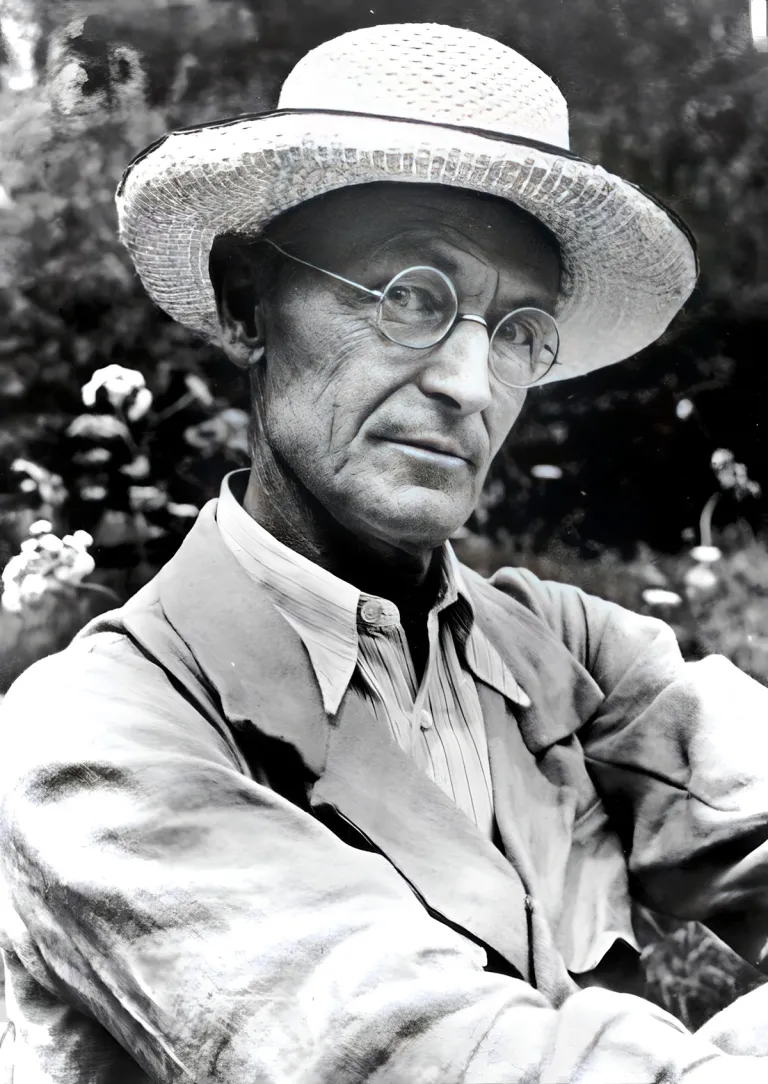
On this multi-fold of human self, Hesse writes -
Even the most spiritual and highly cultivated of men
habitually sees the world and himself through the lenses of
delusive formulas and artless simplifications — and most of all himself.
For it appears to be an inborn and imperative need
of all men to regard the self as a unit.
However often and however grievously this illusion is shattered,
it always mends again…
And if ever the suspicion of their manifold being dawns upon men of unusual powers
and of unusually delicate perceptions, so that, as all genius must,
they break through the illusion of the unity of the personality
and perceive that the self is made up of a bundle of selves,
they have only to say so
and at once the majority puts them under lock and key!
Now, the problem is that once we really appreciate the manifold nature of our self, it is important to go deeper, and weave a thread of a unifying story of unifying principle!
That mysterious super-string binding the bundle.
And here, Hesse says the creation of the illusion of a unity of a personality that gives us a solace, although it is a delusion!
With compassion to this universal human vulnerability to delusion, Hesse says -
Every ego, so far from being a unity
is in the highest degree a manifold world,
a constellated heaven, a chaos of forms, of states and stages,
of inheritances and potentialities.
It appears to be a necessity as imperative as eating and breathing
for everyone to be forced to regard this chaos as a unity
and to speak of his ego as though it were a one-fold
and clearly detached and fixed phenomenon.
Even the best of us shares the delusion.
Considering this ego-self as a kind of optical illusion, Hesse insists that
with courage to break the illusion and enough curiosity about these separate things within,
one can discern across them the “various facets and aspects of a higher unity”
That makes man to see the Unity more clearly.
He writes -
[These selves] form a unity and a supreme individuality;
and it is in this higher unity alone,
not in the several characters,
that something of the true nature of the soul is revealed.
To me it is like that Subliminal mind that is the unifying principle
It is actually not only very revealing, but also gives immense lightness and courage.
Here there is no fear of self preservation. The preservation of that one aspect of the ego.
Rather it is an understanding, a deeper realization that we are multitudes,
And this multitude is experienced in our interpersonal relationships
between minds and minds, and hearts and hearts!
And if that sense of self is a multi-personal unity,
What is there to save that one local part of the bigger self - our little ego?
And if there is no pressure of such phony self-preservation,
An authentic, productive, creative, engagement is possible,
With candor, openness, courage, clarity of the values we stand by as a human race.
And when this fear gradually evaporates, and that courage kindles,
there is a gradual universalization of everything in our lives.
Bertrant Russel insisted that the key to a fulfilling life, is to
make your interests gradually wider and more impersonal,
until bit by bit the walls of the ego recede,
and your life becomes increasingly merged in the universal life.
Hesse, writes on this idea of universalization or subliminalization saying -
if you are ever to find peace
Embark on the longer and wearier and harder road of life.
You will have to multiply many times your two-fold being,
And complicate your complexities still further.
Instead of narrowing your world
And simplifying your soul,
you will have to absorb more and more of the world,
And at last, take all of it up in your painfully expanded soul.
if you are ever to find peace
It is only by nurturing and expanding the soul,
That the self, fluid and fractal, can be held in tenderness.
And without tenderness of the self -
there can be no tenderness for the world.
And no peace within.
Peace within comes from tenderness of the world.
The inherent Tenderness of the world reveals to us,
When we nurture and expand our soul.
and with that expansion, there is a unique tenderness that dawns in us.
And that unique tenderness in us,
Holds together in a cushion of kindness,
The fluid and fractal manifold selves of ours!
And only when we are able hold in comfort, tenderness and in cushion,
Safely and securely, the fluid and fractal manifold selves of ours,
Can we really know our true nature, and our holistic self,
and that dawns in us the profound appreciation of the conglomerate that we belong to.
This inspires self-love.
And from the place of self-love can we really have the capacity
To love the other.
Absence of self-love, is actually another name for that narrow sheer egoism,
Of a simplistic, separated, nuclear unit self.
That breeds cruel isolation and deep despair.
Inspired from - https://www.themarginalian.org/2024/02/18/hesse-soul/?mc_cid=a2e25f3a13&mc_eid=330ec66e92